
In music, as in life, patterns are everywhere — some obvious, some hidden until you learn how to see them.
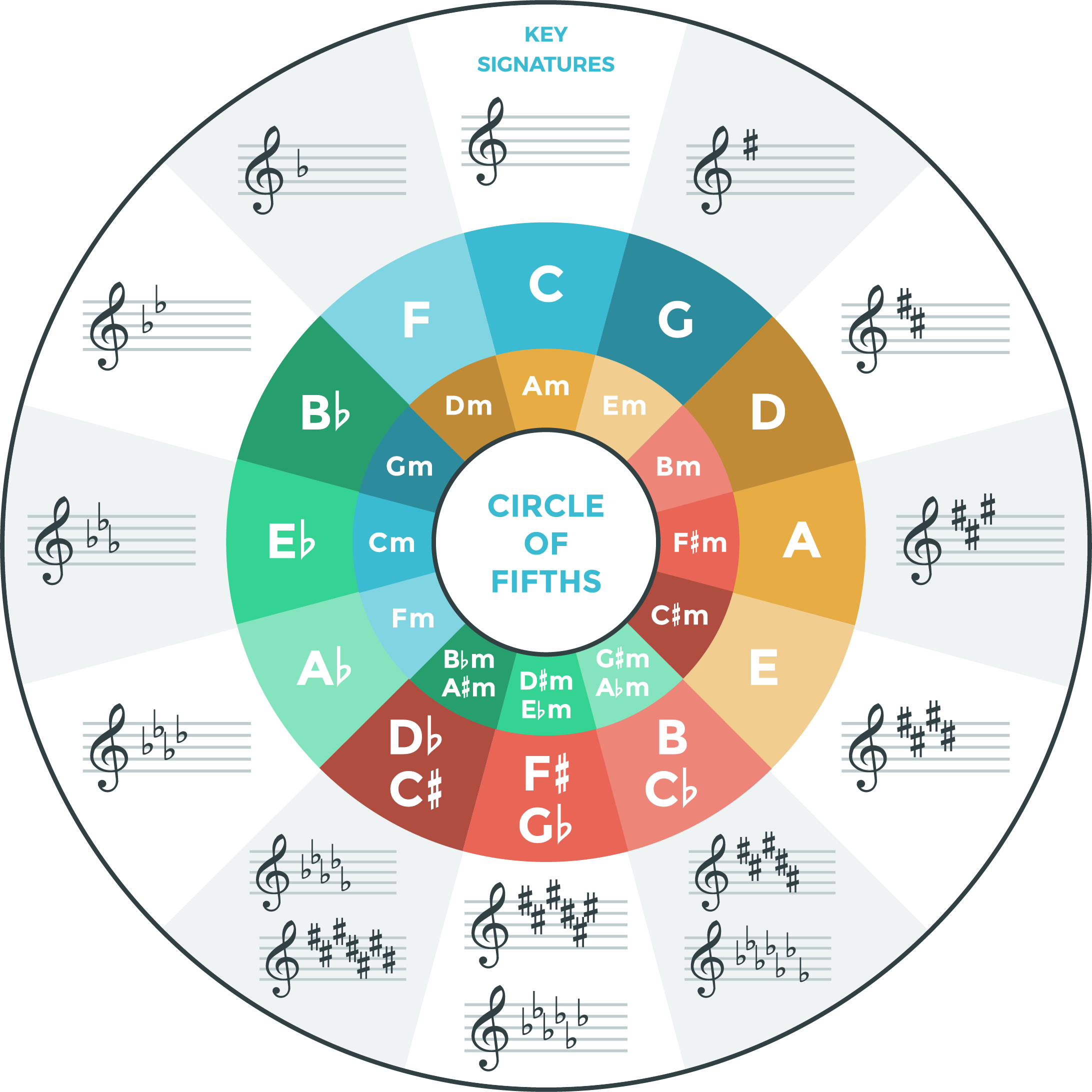
The Circle of Fifths is one of those patterns: a perfect loop of relationships that turns chaos into clarity.
It’s not just a chart for musicians; it’s a map of connection, showing how every key, every chord, every note is part of a greater whole.
The Shape of Harmony
Imagine standing at C major — pure, unaltered, no sharps, no flats.
Step clockwise, and each move is a perfect fifth upward:
C → G → D → A → E → B → F♯ → D♭ → A♭ → E♭ → B♭ → F → back to C.
- Clockwise: Each step adds a sharp, sharpening the tone, like adding light to a canvas.
- Counterclockwise: Each step adds a flat, softening the edges, like dusk settling over a landscape.
- Relative minors: Each major key has a shadow twin — its relative minor — three steps counterclockwise. C’s is A minor, bright and melancholy all at once.
A Story That Began Centuries Ago
The roots of this circle stretch back to Pythagoras, who found harmony in numbers and ratios.
Over centuries, musicians refined it into the modern Circle of Fifths — a tool that’s as useful for a jazz improviser in a smoky bar as it is for a symphony composer in a grand hall.
Why It Matters (Beyond Theory)
- Key Signatures at a Glance – No more guesswork; the circle tells you instantly.
- Smooth Modulation – Move between keys like a storyteller shifting scenes.
- Chord Progressions – Build sequences that feel inevitable, like the turning of seasons.
- Transposition – Change a song’s key without losing its soul.
In Practice
- Composing – Use the circle to chart emotional arcs in your music.
- Improvising – Let it guide you through keys without breaking the flow.
- Arranging – Choose modulations that feel like natural conversations between chords.
- Learning – Anchor your memory in the circle’s symmetry.
A Reflection
The Circle of Fifths is more than a musician’s tool — it’s a reminder that everything is connected.
Keys that seem far apart are only a few steps away if you know the path.
In that way, it’s a lot like relationships, business, and life itself:
the art lies in knowing when to move forward, when to return, and when to let the music resolve.